
Monday, January 4, 2016
The Big Short

"Joy" Review
.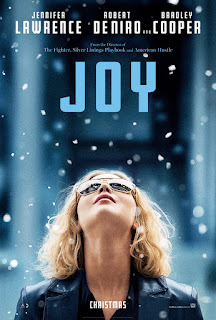 David O. Russell returns with his lucky troop of actors (Jennifer Lawrence, Bradley Cooper, and Robert De Niro) in "Joy".
"Joy" is the story of Joy Mongano, a struggling single mother, who becomes a billionaire after selling her new invention, the Miracle Mop on the Home Shopping Network. Sounds like your pretty standard setup for the popular "rooting for the underdog" kind of story, right? I thought so too, but what I didn't take into account was this sort of material being put into Russell's hands. The result being, for a lack of a better word, utter insanity.
The film bounced back and forth so many different times with its many elements and switching tones that within the first twenty to thirty minutes, all I could think was "What the heck is going on?". It felt like Russell was trying to make the underdog story more interesting to himself by combining elements of "Silver Linings Playbook" and "The Fighter" with a flair of Wes Anderson. But this is done in such a confusing way that it felt like the story was taking place in the 50s or 60s, rather than the late 80s and early 90s when the actual events took place.
This constant back and forth also stifled the potential for some great storytelling with the secondary characters and the actors who played them like Virginia Madsen as Joy's soap opera obsessed mother, Robert De Niro as Joy's father who can't seem to maintain a relationship, and Edgar Ramirez as Joy's ex-husband who is a singer still living in her basement. In the first thirty minutes or so, there are no consistent moments of storytelling or moments where the audience can take a breath with the characters because everything is thrown at you at breakneck speed.
As a result, the emotional moments with these characters is nearly if not completely lost later on , where they are much needed. This is especially true with Diane Ladd as Joy's grandmother, who also serves as the film's narrator but is only in the film for ten to fifteen minutes, and Bradley Cooper as the executive who gives Joy's Miracle Mop a chance and serves as her business mentor. However, the only memorable thing about him was his constant spouting of trivia about the founding executives of movie studios like Louis B. Mayer.
The film also rushes its ending, cutting off the emotional victory the audience should be feeling with Joy and jumping forward in time, mainly to summarize what happened to all the characters, so by the time the credits rolled, I felt confused and emotionally unfulfilled.
The film has two saving graces, however. The first is Jennifer Lawrence as the emotional center of the story. It goes without saying that Lawrence is an acting powerhouse, and here, like in Silver Linings Playbook, she does it again. I could feel the anger and frustration building when we first meet her and felt it explode when Joy breaks down in front of her daughter late in the film. That scene alone was absolutely gut-wrenching and heart-breaking.
The second saving grace, actually due in part to Lawrence, was when Joy first goes to QVC to promote her mop. That scene worked for me because the film started to slow down, the elements were coming together and the audience was allowed to engage with the story and characters. Because of that, I was able to become emotionally hooked for the rest of the movie.
In Summary: Jennifer Lawrence delivers a strong performance as the main character in "Joy" but David O. Russell's inconsistency with the tone and rushing with the storytelling hampers everything else.
Ranking: 3.0 Stars out of 5.
David O. Russell returns with his lucky troop of actors (Jennifer Lawrence, Bradley Cooper, and Robert De Niro) in "Joy".
"Joy" is the story of Joy Mongano, a struggling single mother, who becomes a billionaire after selling her new invention, the Miracle Mop on the Home Shopping Network. Sounds like your pretty standard setup for the popular "rooting for the underdog" kind of story, right? I thought so too, but what I didn't take into account was this sort of material being put into Russell's hands. The result being, for a lack of a better word, utter insanity.
The film bounced back and forth so many different times with its many elements and switching tones that within the first twenty to thirty minutes, all I could think was "What the heck is going on?". It felt like Russell was trying to make the underdog story more interesting to himself by combining elements of "Silver Linings Playbook" and "The Fighter" with a flair of Wes Anderson. But this is done in such a confusing way that it felt like the story was taking place in the 50s or 60s, rather than the late 80s and early 90s when the actual events took place.
This constant back and forth also stifled the potential for some great storytelling with the secondary characters and the actors who played them like Virginia Madsen as Joy's soap opera obsessed mother, Robert De Niro as Joy's father who can't seem to maintain a relationship, and Edgar Ramirez as Joy's ex-husband who is a singer still living in her basement. In the first thirty minutes or so, there are no consistent moments of storytelling or moments where the audience can take a breath with the characters because everything is thrown at you at breakneck speed.
As a result, the emotional moments with these characters is nearly if not completely lost later on , where they are much needed. This is especially true with Diane Ladd as Joy's grandmother, who also serves as the film's narrator but is only in the film for ten to fifteen minutes, and Bradley Cooper as the executive who gives Joy's Miracle Mop a chance and serves as her business mentor. However, the only memorable thing about him was his constant spouting of trivia about the founding executives of movie studios like Louis B. Mayer.
The film also rushes its ending, cutting off the emotional victory the audience should be feeling with Joy and jumping forward in time, mainly to summarize what happened to all the characters, so by the time the credits rolled, I felt confused and emotionally unfulfilled.
The film has two saving graces, however. The first is Jennifer Lawrence as the emotional center of the story. It goes without saying that Lawrence is an acting powerhouse, and here, like in Silver Linings Playbook, she does it again. I could feel the anger and frustration building when we first meet her and felt it explode when Joy breaks down in front of her daughter late in the film. That scene alone was absolutely gut-wrenching and heart-breaking.
The second saving grace, actually due in part to Lawrence, was when Joy first goes to QVC to promote her mop. That scene worked for me because the film started to slow down, the elements were coming together and the audience was allowed to engage with the story and characters. Because of that, I was able to become emotionally hooked for the rest of the movie.
In Summary: Jennifer Lawrence delivers a strong performance as the main character in "Joy" but David O. Russell's inconsistency with the tone and rushing with the storytelling hampers everything else.
Ranking: 3.0 Stars out of 5.
 David O. Russell returns with his lucky troop of actors (Jennifer Lawrence, Bradley Cooper, and Robert De Niro) in "Joy".
"Joy" is the story of Joy Mongano, a struggling single mother, who becomes a billionaire after selling her new invention, the Miracle Mop on the Home Shopping Network. Sounds like your pretty standard setup for the popular "rooting for the underdog" kind of story, right? I thought so too, but what I didn't take into account was this sort of material being put into Russell's hands. The result being, for a lack of a better word, utter insanity.
The film bounced back and forth so many different times with its many elements and switching tones that within the first twenty to thirty minutes, all I could think was "What the heck is going on?". It felt like Russell was trying to make the underdog story more interesting to himself by combining elements of "Silver Linings Playbook" and "The Fighter" with a flair of Wes Anderson. But this is done in such a confusing way that it felt like the story was taking place in the 50s or 60s, rather than the late 80s and early 90s when the actual events took place.
This constant back and forth also stifled the potential for some great storytelling with the secondary characters and the actors who played them like Virginia Madsen as Joy's soap opera obsessed mother, Robert De Niro as Joy's father who can't seem to maintain a relationship, and Edgar Ramirez as Joy's ex-husband who is a singer still living in her basement. In the first thirty minutes or so, there are no consistent moments of storytelling or moments where the audience can take a breath with the characters because everything is thrown at you at breakneck speed.
As a result, the emotional moments with these characters is nearly if not completely lost later on , where they are much needed. This is especially true with Diane Ladd as Joy's grandmother, who also serves as the film's narrator but is only in the film for ten to fifteen minutes, and Bradley Cooper as the executive who gives Joy's Miracle Mop a chance and serves as her business mentor. However, the only memorable thing about him was his constant spouting of trivia about the founding executives of movie studios like Louis B. Mayer.
The film also rushes its ending, cutting off the emotional victory the audience should be feeling with Joy and jumping forward in time, mainly to summarize what happened to all the characters, so by the time the credits rolled, I felt confused and emotionally unfulfilled.
The film has two saving graces, however. The first is Jennifer Lawrence as the emotional center of the story. It goes without saying that Lawrence is an acting powerhouse, and here, like in Silver Linings Playbook, she does it again. I could feel the anger and frustration building when we first meet her and felt it explode when Joy breaks down in front of her daughter late in the film. That scene alone was absolutely gut-wrenching and heart-breaking.
The second saving grace, actually due in part to Lawrence, was when Joy first goes to QVC to promote her mop. That scene worked for me because the film started to slow down, the elements were coming together and the audience was allowed to engage with the story and characters. Because of that, I was able to become emotionally hooked for the rest of the movie.
In Summary: Jennifer Lawrence delivers a strong performance as the main character in "Joy" but David O. Russell's inconsistency with the tone and rushing with the storytelling hampers everything else.
Ranking: 3.0 Stars out of 5.
David O. Russell returns with his lucky troop of actors (Jennifer Lawrence, Bradley Cooper, and Robert De Niro) in "Joy".
"Joy" is the story of Joy Mongano, a struggling single mother, who becomes a billionaire after selling her new invention, the Miracle Mop on the Home Shopping Network. Sounds like your pretty standard setup for the popular "rooting for the underdog" kind of story, right? I thought so too, but what I didn't take into account was this sort of material being put into Russell's hands. The result being, for a lack of a better word, utter insanity.
The film bounced back and forth so many different times with its many elements and switching tones that within the first twenty to thirty minutes, all I could think was "What the heck is going on?". It felt like Russell was trying to make the underdog story more interesting to himself by combining elements of "Silver Linings Playbook" and "The Fighter" with a flair of Wes Anderson. But this is done in such a confusing way that it felt like the story was taking place in the 50s or 60s, rather than the late 80s and early 90s when the actual events took place.
This constant back and forth also stifled the potential for some great storytelling with the secondary characters and the actors who played them like Virginia Madsen as Joy's soap opera obsessed mother, Robert De Niro as Joy's father who can't seem to maintain a relationship, and Edgar Ramirez as Joy's ex-husband who is a singer still living in her basement. In the first thirty minutes or so, there are no consistent moments of storytelling or moments where the audience can take a breath with the characters because everything is thrown at you at breakneck speed.
As a result, the emotional moments with these characters is nearly if not completely lost later on , where they are much needed. This is especially true with Diane Ladd as Joy's grandmother, who also serves as the film's narrator but is only in the film for ten to fifteen minutes, and Bradley Cooper as the executive who gives Joy's Miracle Mop a chance and serves as her business mentor. However, the only memorable thing about him was his constant spouting of trivia about the founding executives of movie studios like Louis B. Mayer.
The film also rushes its ending, cutting off the emotional victory the audience should be feeling with Joy and jumping forward in time, mainly to summarize what happened to all the characters, so by the time the credits rolled, I felt confused and emotionally unfulfilled.
The film has two saving graces, however. The first is Jennifer Lawrence as the emotional center of the story. It goes without saying that Lawrence is an acting powerhouse, and here, like in Silver Linings Playbook, she does it again. I could feel the anger and frustration building when we first meet her and felt it explode when Joy breaks down in front of her daughter late in the film. That scene alone was absolutely gut-wrenching and heart-breaking.
The second saving grace, actually due in part to Lawrence, was when Joy first goes to QVC to promote her mop. That scene worked for me because the film started to slow down, the elements were coming together and the audience was allowed to engage with the story and characters. Because of that, I was able to become emotionally hooked for the rest of the movie.
In Summary: Jennifer Lawrence delivers a strong performance as the main character in "Joy" but David O. Russell's inconsistency with the tone and rushing with the storytelling hampers everything else.
Ranking: 3.0 Stars out of 5.
Monday, December 14, 2015
Bridge of Spies
In 1957, a Russian spy is captured in Brooklyn and insurance lawyer James Donovan is given the thankless task of being his defense lawyer in court. When an American spy is shot down over the Soviet Union, however, Donovan is asked to negotiate the trade between the two men in the now divided Berlin, and must tread a tightrope so treacherous, it could not only get himself captured or killed, but cause tensions between the two countries to blow.
Tom Hanks gives a wonderful performance as Donovan, dutiful to his job, the Constitution, and the practice of law, as do the rest of the cast, especially Mark Rylance as the captured Russian spy Rudolph Abel, and Mikhail Gorevoy as a contact who Donovan meets at the Russian embassy in Berlin (who reminded me a lot of Peter Lorre).
Spielberg perfectly captures the look and feel of the 50s era both in America and the split Berlin. With America, its not only the lighthearted nostalgic stuff like the cars, the wardrobe, and the media (77 Sunset Strip and Duck and Cover) but also the paranoia and hatred for the Soviet Union.
This is masterfully done in two scenes: one when Donovan is riding the subway while the other passengers are reading newspapers and they slowly realize Donovan is the defense lawyer for Abel and start to give him the evil eye. Two, when Donovan's son and his classmates are watching Duck and Cover and you can see the terror in their faces as they watch the bombs go off. Both scenes were just so powerfully and nerve wrackingly shot. (I had to laugh though at a scene following the latter when Donovan's son fills all the sinks and bathtubs with water so they could be prepared for when the bombs drop, because I remember hearing Spielberg tell that story in a documentary and knew that was a personal moment of his.
The conditions in East and West Berlin are also hauntingly portrayed as both areas are starting to deteriorate with fear and anguish as family and friends are separated from each other by the newly built Berlin Wall; the terror as people trying to cross are killed or detained, stirring echoes of Schindler's List. What I think the film does best is its slow building of the characters' processes with the addition of tension, such as the opening with Abel going through his daily routine while being tailed by FBI agents. But the film also has a refreshing willingness to look past the paranoia and hatred to humanize the important characters.
While not as impactful as something like Schindler's List, Saving Private Ryan, or even something out of Spielberg's pure entertainment films like Jaws, there are enough tension filled moments peppered throughout to keep you interested and on edge throughout the story, especially when it shows the dangers of Soviet occupied Berlin and certain pickles that Donovan gets caught in, like with the guards or a street gang in East Berlin, and especially the climatic scene at the bridge where its a waiting game.
At the same time though with that climax, I felt uplifted and heartwarmed because the relationship between Donovan and Abel was shown to have really grown and you got to see them all as real characters and human beings: Abel was not an evil scheming spy but just a man doing his job and willing to die for it, Powers, the captured pilot, was not just shown as some coward but a man who did his job, protected secrets, but was not willing to die for it, etc and I think that really helped the movie stand out for me.
Spielberg always does a fantastic job capturing the 50s and I hope he gets the chance to do another film in this era soon (possibly of the sci-fi variety). While not as strong as Spielberg's other historical films like Saving Private Ryan or Schindler's List, Bridge of Spies is a solid addition to that side of his library and a side I always look forward to because not only do I love learning about history and culture of the past, but Spielberg always manages to tell a great story about a subject that I never knew before and that makes my love for history and his work that much stronger.
Some people might be off put that Bridge of Spies doesn't have much action in it (which might explain the lukewarm box office) and is mostly talking but they shouldn't let that stop them because the conversations in this film are so well written and filmed that it really works and that should be enough. An old fashioned thriller of the mind like a lot of old Cold War spy movies were. I say definitely see it.
Final Rating: 3.7 stars out of 5.
(Final Note: I find it kind of weird and ironic that both Steven Spielberg and Robert Zemeckis both had new films come out this year and both were solidly good but are having lukewarm box office results, whereas the anniversaries of Jaws and Back to the Future are getting way more attention. The Walk and Bridge of Spies definitely do deserve to get some recognition and box office success at least. Definitely check them out as well.)
Tom Hanks gives a wonderful performance as Donovan, dutiful to his job, the Constitution, and the practice of law, as do the rest of the cast, especially Mark Rylance as the captured Russian spy Rudolph Abel, and Mikhail Gorevoy as a contact who Donovan meets at the Russian embassy in Berlin (who reminded me a lot of Peter Lorre).
Spielberg perfectly captures the look and feel of the 50s era both in America and the split Berlin. With America, its not only the lighthearted nostalgic stuff like the cars, the wardrobe, and the media (77 Sunset Strip and Duck and Cover) but also the paranoia and hatred for the Soviet Union.
This is masterfully done in two scenes: one when Donovan is riding the subway while the other passengers are reading newspapers and they slowly realize Donovan is the defense lawyer for Abel and start to give him the evil eye. Two, when Donovan's son and his classmates are watching Duck and Cover and you can see the terror in their faces as they watch the bombs go off. Both scenes were just so powerfully and nerve wrackingly shot. (I had to laugh though at a scene following the latter when Donovan's son fills all the sinks and bathtubs with water so they could be prepared for when the bombs drop, because I remember hearing Spielberg tell that story in a documentary and knew that was a personal moment of his.
The conditions in East and West Berlin are also hauntingly portrayed as both areas are starting to deteriorate with fear and anguish as family and friends are separated from each other by the newly built Berlin Wall; the terror as people trying to cross are killed or detained, stirring echoes of Schindler's List. What I think the film does best is its slow building of the characters' processes with the addition of tension, such as the opening with Abel going through his daily routine while being tailed by FBI agents. But the film also has a refreshing willingness to look past the paranoia and hatred to humanize the important characters.
While not as impactful as something like Schindler's List, Saving Private Ryan, or even something out of Spielberg's pure entertainment films like Jaws, there are enough tension filled moments peppered throughout to keep you interested and on edge throughout the story, especially when it shows the dangers of Soviet occupied Berlin and certain pickles that Donovan gets caught in, like with the guards or a street gang in East Berlin, and especially the climatic scene at the bridge where its a waiting game.
At the same time though with that climax, I felt uplifted and heartwarmed because the relationship between Donovan and Abel was shown to have really grown and you got to see them all as real characters and human beings: Abel was not an evil scheming spy but just a man doing his job and willing to die for it, Powers, the captured pilot, was not just shown as some coward but a man who did his job, protected secrets, but was not willing to die for it, etc and I think that really helped the movie stand out for me.
Spielberg always does a fantastic job capturing the 50s and I hope he gets the chance to do another film in this era soon (possibly of the sci-fi variety). While not as strong as Spielberg's other historical films like Saving Private Ryan or Schindler's List, Bridge of Spies is a solid addition to that side of his library and a side I always look forward to because not only do I love learning about history and culture of the past, but Spielberg always manages to tell a great story about a subject that I never knew before and that makes my love for history and his work that much stronger.
Some people might be off put that Bridge of Spies doesn't have much action in it (which might explain the lukewarm box office) and is mostly talking but they shouldn't let that stop them because the conversations in this film are so well written and filmed that it really works and that should be enough. An old fashioned thriller of the mind like a lot of old Cold War spy movies were. I say definitely see it.
Final Rating: 3.7 stars out of 5.
(Final Note: I find it kind of weird and ironic that both Steven Spielberg and Robert Zemeckis both had new films come out this year and both were solidly good but are having lukewarm box office results, whereas the anniversaries of Jaws and Back to the Future are getting way more attention. The Walk and Bridge of Spies definitely do deserve to get some recognition and box office success at least. Definitely check them out as well.)
Sunday, December 13, 2015
The Walk
Robert Zemeckis's latest film is the true story about Phillipe Petit, an eccentric French street performer and tight rope artist, who is inspired to tight rope between the recently completed Twin Towers of the World Trade Center in 1974 despite all the risks in front of him.
Like Flight beforehand, Zemeckis is back in good form with this one, showing his skillful weaving of a good story, strong characters, and especially his mastery of special effects, with the film's centerpiece: Petite's walk between the Two Towers with absolutely flawless CGI. The Walk sequence alone is worth the price of admission whether in 2D or 3D (people queasy of heights, be warned) and is pure cinema: dream-like, filled with imagination and emotion.
Joseph Gordon-Levitt is wonderfully cast as Petit, giving boundless energy and vigor, supported by cast members such as Ben Kingsley and Charlotte Le Bon who all work well together and give them enough personality to stick out as individuals.
The film is a good companion piece to the documentary about Petite's exploits, Man on Wire (I personally prefer The Walk but I may need to Man on Wire again).
Where I feel the film suffers though is in the first half . From the beginning of the film up to sneaking into the Towers, which is stylized very nicely as kind of like a heist movie, and the Walk sequence, the film moves at a brisk pace: slow enough that we get to know and like the characters but not enough moments of getting into Petite's head and seeing him digest a situation. As a result, there were moments where I was looking at Petit from the outside but then it started to pick up as the story moved along and I was with him emotionally by the time of the heist.
It also may be because I was thinking back to Man on Wire but I was surprised when the film suddenly jumped from the preparation into the night before the heist as I was expecting more problems to arise and build even higher to the climax, so that may be another reason why I felt the film suffered a bit in the first half.
Still, the film totally pays off in the end with the wonderful climax and especially with the final lingering shot, which made me miss the Twin Towers and think of when I got to visit them in the 90s.
While not up there with Zemeckis's classics like Back to the Future or Who Framed Roger Rabbit, The Walk is still a solidly good film and definitely deserves to be seen (and definitely needs better box office numbers). It reminded me a lot of The Polar Express, another underrated Zemeckis film, as both harken back to a more innocent and dream-filled time and have a bittersweet ending, that still makes you feel good.
Same with the 2004 version of Around the World in 80 Days with its innocence, comradery and achieving an impossible dream despite the odds.
Final Verdict: Despite its pacing moments in the first half, The Walk has a strong story, great performances, good characters and an absolutely amazing and inspiring finale that had me walking on air so to speak as I left the theater.
I definitely say see it.
Rating: 3.4 stars out of 5
The Martian
A science-fiction survival story about an astronaut who, believed to be dead, is accidentally left behind during a mission to Mars and must use what little resources he has to survive until he can be rescued (but not for 4 years) or until his resources run out and he perishes.
I'm going to say it right up front that even though I've only seen a couple of Ridley Scott's films (Alien and Blade Runner included), this is definitely one of my top favorites if not my top favorite film of his that I've seen so far (not to mention one of the best films he's done in a while) and proves my theory that Scott is an excellent visual director but even better when he has a strong script to back him up.
The Martian is definitely the latter as Scott gives us very rich visuals, making the surface of Mars look both beautifully and harshly realistic and NASA back on Earth a nice mix of advanced technology grounded in the present mixed with the beauty of business related architecture, all the while being backed up by a very strong script, cast and crew.
The script is wonderfully written combining compelling scientific info (that left me leaving the theater feeling smarter and well-educated), slick comedy, suspenseful tension and powerful drama all into one.
Matt Damon is wonderful as the lead, effortlessly oozing likability and sympathy from the audience within the first fifteen minutes and easily carrying most of the action on his own, but things are made even better as he's joined by a rich cast of actors ranging from Jessica Chastain and Jeff Daniels to Kristen Wiig and Donald Glover, all given enough personality and character for you to understand and like them.
The Martian reminded me a lot of Apollo 13 (and I mean that with the fondest of comparisons as Apollo 13 is one of my favorite films from the 90s and The Martian is definitely of that caliber) in that both dealt with the people at NASA working together to help solve the many problems of getting an astronaut (or three astronauts in Apollo 13's case) back home safe.
Just that mixture of intelligent well educated people working hard to overcome overbearing obstacles through stubborn optimism, ingenuity, sacrifice, and compassion is just something I've always enjoyed seeing with admiration and inspiration and has helped steer my world views in terms of facing obstacles.
If I had any issues with the movie, they were extreme nitpicks (and I mean nitpicks smaller than Ant-Man at microscopic level here) such as it seemed like Jeff Daniels was going to become a evil corporate head stereotype at one point but didn't (thankfully), the rest of the Mars crew's relationships with their families being breezed over a bit, and then a couple of times where it jumped too far ahead in time too quickly but I can understand why with all three so they weren't really issues at all.
Even though we still have quite a few films coming out before the end of the year, I can definitely say that the Martian is one of my top favorites of the year. I definitely say see it. Its a blast!
Final Rating: 4.2 stars out of 5
Sunday, June 14, 2015
Jurassic World
Just got back from seeing Jurassic World (Also have seen Mad Max: Fury Road (FINALLY!) and Slow West. I'll try to have reviews for those by the end of the week). This time the park is open, and with it comes the 21st century where dinosaurs are now so common place, that kids prefer to look at their phones. (a quirky idea and an interesting one although a bit hard to swallow at the same time).
The film stars Chris Pratt and Bryce Dallas Howard as the park's raptor trainer and operations manager respectfully as well as Nick Robinson and Ty Simpkins as the nephews of Howard's character who must get out of the park when its newest creation, the Indominus Rex, a genetic hybrid of several different animals breaks free. This storyline is fairly creative as it allows for exploration of certain sci-fi themes like genetic splicing as well as progressing the themes slightly from the original film with the raptors being trained and possibly becoming weapons of war. At the same time , it also brought up the "mad scientist"/Frankenstein kind of theme with B.D. Wong's Dr. Henry Wu as well but doesn't do anything real fresh with it (unless that's planned for a sequel) (It may just be personal preference speaking too but I didn't really like the way they went with Wu's character but I think that's because I preferred how he was portrayed in the first film and keep thinking of Wong's portrayal of Shang in Mulan).
Character-wise, the film is a bit of mess. The most complete and fairly effective arcs are Bryce Dallas Howard's character and Vincent D'onofrio's character who plays his role with glee (honestly, why doesn't the dude have an Oscar nomination yet?) even though I pretty much knew what was going to happen. The nephews' character arcs kind of bounce around a bit in the beginning with the older brother being the stupid stereotypical teenage boy who only likes to listen to music and look at girls (yeah yeah, I know that's a part of real life but its a stupid overused part of real life) and the mother says he's a bit mean to his brother but I never saw that part of his character) but wrap up pretty well in the end, although the younger brother's intelligence never sank in with me as much as Tim's did from the first movie. The CEO of the park's character even bounces around a bit with him sometimes being a smart likable guy to making some pretty stupid decisions. Chris Pratt as Owen, while not necessarily having an arc was still quite charismatic and likable, and its those things plus his confidence and old fashioned bravado that I think make him a great actor and a fun one to follow, including in this film. He and the other actors do have some good chemistry as there were some good laughs and touching moments as well. There's even a quirky funny control room guy who throughout the movie was giving some hilarious rather intelligent commentary on what was going on.
Visually, the park itself is amazing and creatively a lot of fun. I'd definitely want to visit this place if I could. It was a bit strange though as this turned out to be one of the more emotional and darker films in the Jurassic Park series whereas the other three were focused on suspense and tension while being fairly light with the character personalities but that mixed with the familiarity of character arcs from the other ones in this one made the tone feel a bit off.
One of the biggest problems that I had with the film and another element that makes Jurassic World darker is that innocent people are attacked and killed including a side character who is given literally no personally or character depth at all who is viciously drowned and eaten, and she happens to be female, the first ever female death in a Jurassic Park movie. (Yes I know innocent people have been attacked/killed in the Jurassic Park films before but those worked a bit better because they were individual kills that set the tone of the film really well like the opening of the first one, amplified the terror of the situation like the T-Rex in San Diego in The Lost World, or gave some added weight to the characters like Jurassic Park III and while I get they were going in a new direction and trying to keep things fresh by showing the tourists bandaged up and scared as a way of telling the corporate heads, "You see? Stuff like this is going to happen if you keep doing this!", the fact that it was a large group of people with kids just didn't sit right with me tonally (maybe I'm just a big softie/too sensitive. I don't know).
Finally, there are a few fun visual callbacks to the original film that were done in a creative way but at the same time, with all the problems I was having with the film, it ended up being one of those kind of sequels where it was making me miss and wanting to watch the original. Which is a shame because Jurassic World is directed by Colin Trevorrow who directed the wonderful sci-fi romantic comedy Safety Not Guaranteed, a film I highly recommend.
Overall, there were a lot of elements that bugged me but that's possibly because I wasn't in the right mood and or I had nostalgia goggles on from the first three films. There are a lot of good creative elements, the actors work well together and are charismatic, the story has some interesting sci-fi themes, and the final fight is quite awesome and if those sound good to you, I definitely say see it. I may have to see again myself but for right now, I personally give it a 2.8 out of 5.
Subscribe to:
Posts (Atom)